
A short history of why shutters outlast fashions
Interior shutters are not a recent import. Many Georgian and Victorian British houses were built with folding timber shutters set into the window reveals, closed at night for warmth and security and folded back into boxed recesses by day. If you have ever seen a deep, panelled window surround in an older house, that is usually where they lived.
Modern plantation shutters are a louvred evolution of the same idea. The blades are wider than the narrow slats of traditional shutters, so the view out is more open and the light control is easier. The principle is the same, though: a framed timber or composite panel, hinged to the window opening, that you can close, tilt or fold away.
That fixed, architectural quality is a big part of why they last. Because shutters are fitted to the frame and made to the exact size of the opening, they read as part of the building rather than as a soft furnishing. Nobody thinks of a good staircase or a panelled door as "this year's look", and well-made shutters sit in a similar category.
Fashion cycles hit fabrics, colours and patterns hardest. A bold geometric print or a very particular shade of sage can date a room within a few years, and curtains and blinds carry a lot of both. Built-in joinery tends to age more slowly, because the shape matters more than the surface.
Compare that with roller and Roman blinds, which are cheaper to replace when taste changes. That is a genuine advantage of blinds, and it is worth being honest about. It also explains the logic on the other side: if you are buying something that stays for fifteen years or more, the design needs to be quieter and better proportioned than a passing trend.
There is a fair counter-argument, and it is the one the sceptics usually make. Shutters have had several waves of popularity in Britain, and each wave left behind a batch of installations that now look of their moment: heavy, high-gloss, narrow-louvred sets fitted in the same white to every window regardless of the house. When people say shutters are "out", they are usually picturing those. The category itself has not gone anywhere. What has gone is the one-size-fits-all approach.
How the look has changed: what 'current' means now
The plantation shutter of ten or fifteen years ago was often chunky, glossy and a bit generic. The current look is more considered. Frames are slimmer, hinges are chosen to sit tidily rather than shout, and tilt rod choices are made deliberately, with hidden tilt mechanisms where they suit the window and the budget.
Shape is the other big shift. Made-to-measure work now follows the architecture instead of forcing a rectangle onto it. Arches, angled bays, gable-shaped tops and skylight windows can all be fitted with shutters cut to the exact line of the frame, which is what stops them looking like an afterthought.
Layouts that suit how rooms are used
Café style shutters, which cover only the lower half of the window, are rising for wider openings and street-facing rooms. You keep privacy at eye level from the pavement and let daylight in above. If that sounds like your front room, our café style shutters page shows how the layout works in practice.
Tier-on-tier is the natural choice for living rooms where privacy and light need adjusting independently. The top and bottom sections have their own hinges and tilt rods, so you can close the lower half for privacy and keep the upper louvres open to the sky. It is a practical answer to a very British problem: a sitting room that faces the road.
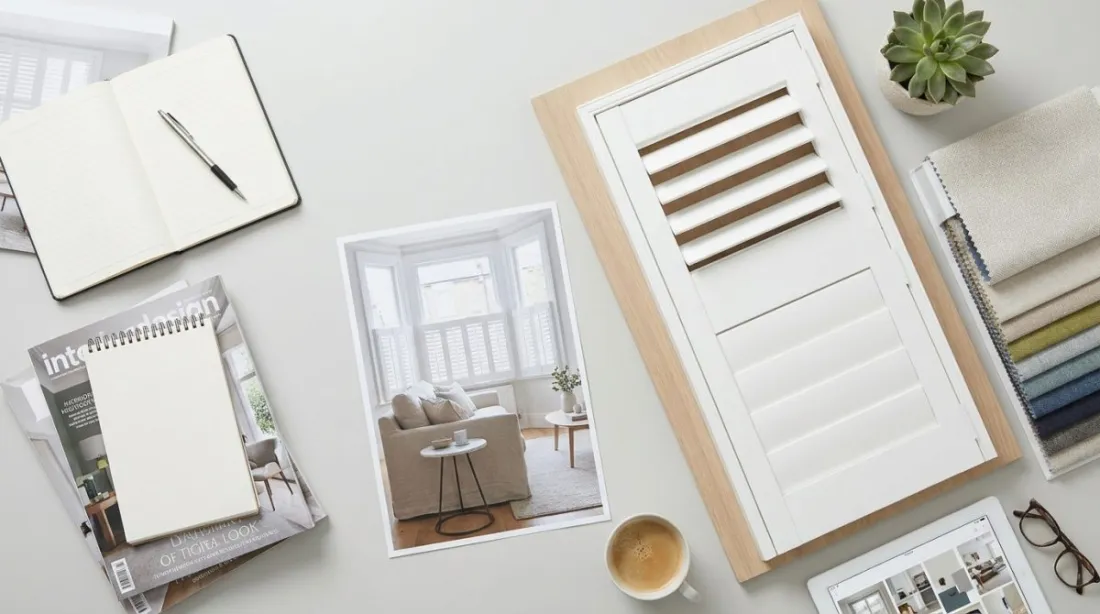
Some people simply want something less louvred. Shutter and shade combinations pair a fixed or tilting section with a fabric shade, and solid panel shutters have no louvres at all, closing like a panelled door over the glass. Both feel closer to traditional interior joinery than to a blind, and they suit bedrooms and period rooms well.
Colour has loosened up
Crisp white remains a firm favourite, and for good reason: it is clean, reflects light and goes with almost everything. But warmer whites, soft greys and deeper colours are now more common. Many people find a warm white looks gentler against cream walls or old plaster than a bright, cold white does, and a muted grey can work well in a modern kitchen.
Louvre size, frame and finish: the details that date a shutter
Most of what makes a shutter look dated or fresh comes down to a handful of proportions. None of them are exotic, but they are easy to get wrong if you choose from a catalogue picture rather than from your own window.
Blade size
Louvre blades commonly run from about 47mm up to 114mm. Larger blades give a more open view and fewer moving parts, which means a cleaner look and less to wipe. Smaller blades feel more traditional and can suit a smaller, older window well.
A sensible rule of thumb is to match blade width to window height. A 63mm or 76mm blade suits many sash and casement windows, while 89mm or 114mm works better on larger, taller panes. Put a 114mm blade on a small cottage window and it looks oversized; put a 47mm blade on a big floor-to-ceiling opening and it looks fussy.
The numbers make the point. A panel 1,200mm high with 114mm blades has only about ten louvres, so each one is a strong, deliberate line and the view through them is generous. The same panel with 63mm blades has nearer nineteen, and the eye reads them as a fine, busy texture. Neither is wrong, but the first suits a modern room and the second a small period one. If you are torn, hold a cut sample against the glass and step back to the other side of the room, because that is the distance from which you will actually see it.
Tilt rod and mid rail
A visible centre tilt rod is the more traditional choice and is cheaper. A hidden tilt looks cleaner and more contemporary, because the blades move without a rod running down the middle. Neither is wrong, so it comes down to the room and your budget. One practical point: on very tall panels a visible rod can be awkward to reach, which is one reason many tall windows are split into two tiers with a rod on each.
Mid rails, the horizontal bars that split a panel, should not be placed at random. Line them up with the meeting rail of a sash window or the transom of a casement, so the shutter divides the glass the same way the window already does. When they miss that line, the eye catches it straight away, even if you cannot say why. As an example, if the meeting rail of your sash sits 740mm above the sill, a mid rail placed at 700mm or 800mm will look slightly off, while one at 740mm looks as though the window and shutter were designed together. Tell your surveyor which line you want to follow, and ask to see where the rail will fall before anything is cut.
Fit and finish
Even shadow gaps all around matter more than any trend. A shutter with a tight, consistent gap on every side looks built in, while uneven gaps look like a bodge, however fashionable the style. This is why accurate measuring is central: if the opening is out of square, which most older houses are, the shutter has to be made to that real shape.
To see how much this matters, picture a Victorian bay where the reveal measures 1,200mm across at the top but 1,188mm at the bottom, because the wall has settled. A panel built to the wider figure will not close properly at the base. One built to the narrower figure leaves a 12mm gap at the top that you can see daylight through. Good surveyors measure width at the top, middle and bottom and height on the left, middle and right, then build to the tightest figure and use a shaped frame or a small, neat packing detail to make up the difference. Anyone who takes a single measurement per window is guessing.
Then there is the finish. Matt or satin looks more modern than high gloss, which shows every fingermark and can look plasticky. A soft satin paint also hides small imperfections in the surface and tends to look better as the light changes through the day.
Colour: light, dark and everything between
Lighter shutters are almost always a safe choice, and they suit most UK homes. That matters because plenty of our rooms don't get much sun: a north-facing terrace front room, a small hallway, a bedroom shaded by the house next door. White and soft off-white louvres bounce what daylight there is back into the room, and they sit quietly against walls in almost any colour.
Darker shutters in charcoal, deep green or navy can look superb, but they work best when used with confidence. Think of a large, bright room with tall windows, or a deliberate feature where the shutters are meant to be noticed. In a small, dim room the same colour tends to shrink the window and make the space feel heavier than you intended.
The best guidance we've seen on this is simple: choose for the room's size, light and purpose, not for what is trending on Instagram or Pinterest. A colour that looks wonderful in a photographed loft apartment may do nothing for your 1960s semi.
Match what is already there
If you go white, match your existing joinery. Shutters that are the same white as your skirting boards, door frames and window frames usually look calmer than a near-miss white. A slightly creamy shutter beside a bright, cold white frame looks like a mistake, even if people can't say why. If your frames are an older, yellowed white, do not try to match that exactly, because it will look dingy once the shutter is new. A clean warm white sits better, and you can repaint the frames later if they bother you.
Test before you commit
Put painted samples against the actual window and look at them in morning and evening light. A north-facing room can turn a crisp white greyish, while a south-facing one can make the same sample look warm and yellow. Check it again with the lamps on, because that's when you'll see it most.
Two practical points on dark finishes. They show dust and fingermarks more, so expect to wipe them a little more often. They also absorb more heat, which is worth knowing on south-facing glass where the louvres sit in direct sun for hours.
Material matters: wood, PVC, aluminium and moisture
For most homeowners, the choice comes down to basswood versus PVC. Basswood is a fine-grained hardwood that's lighter than many people expect. It takes crisp painted finishes and good stains, and the grain looks right up close. PVC is waterproof and easier to wipe down, which makes it the practical pick when the room is going to get splashed or steamy.
That's why moisture should drive the decision in bathrooms, kitchens and utility rooms. Moisture-resistant or fully waterproof shutters suit these spaces far better than untreated timber. Our waterproof Hollywood shutters are one example, made from ABS composite for exactly this sort of room. For conservatories and outdoor use, aluminium is another option, as it copes with temperature swings and weather in a way timber doesn't.
A sensible rule is to think about where the water comes from. A shutter beside a bath or a shower screen takes direct splashes and steam several times a day, so it should be fully waterproof. A kitchen window above a sink is similar. A kitchen window across the room from the hob is a milder case, and a sealed, well-painted timber shutter is usually fine there as long as the room has an extractor and you wipe up grease occasionally. Living rooms and bedrooms rarely need more than a normal painted finish.
Shaped windows and material
Arches and other shaped openings often need wood or composite, because those materials can be cut accurately to a template. Cheaper boards can chip or splinter on a curve, and a gap at the edge of an arch is very obvious. If you have a shaped window, ask what the shutter will actually be made from before you ask about colour.
Material also decides how a shutter ages, and ageing is what makes shutters look tired long before the style does. Three things do most of the damage:
- Warping, usually from poor-quality boards or heat and damp the material wasn't built for.
- Yellowing, which is a known problem in cheap PVC, particularly on bright windows.
- Chipped paint, especially on edges and louvre tips that get handled every day.
A shutter with a sound core and a properly cured finish will still look sharp in ten years. One with a thin coat and a weak board will look worn in three, however fashionable the design was. When you compare suppliers, ask how many coats are applied, whether the finish is sprayed and cured or simply brushed, and what the guarantee actually covers. A long guarantee that excludes fading and warping is worth less than it sounds.
Ask about weight
On wide spans, weight is worth asking about. A heavy panel needs properly specified hinges and a frame that can carry it, otherwise it sags and the louvres stop lining up. A good fitter will tell you how a wide window will be divided into panels and what the hardware is rated for. As a guide, a single panel much wider than about 800mm or 900mm in solid timber is asking for trouble, which is why wider windows are normally split into two or more hinged panels rather than one big door.

Matching shutters to the house: period homes, new builds and awkward windows
A shutter that's right for one house can look wrong in another. The style, louvre size and frame should all take their cue from the building, and the windows in particular.
Victorian and Edwardian terraces
Bays are the signature feature here, and they suit full-height or tier-on-tier shutters. Choose the louvre size to respect the proportions of the sash windows. A louvre that's too wide can overwhelm a narrow sash, while one that's too fine can look fussy across a big bay.
Georgian and Regency houses
Solid or panelled shutters and narrower louvres sit most naturally here. They echo the folding internal shutters these houses often had originally. Keeping the frame slim and the detailing restrained helps the shutters look like they belong to the room rather than being added to it.
1930s semis and new builds
Larger louvres and simpler frames suit flat, modern windows without fuss. These windows often have no deep reveal or architectural detail to work with, so clean lines do the job better than anything elaborate. A plain white shutter with a wide louvre is hard to get wrong.
Many of these houses have uPVC windows with handles that stand proud of the frame, and often a window board that is only a few centimetres deep. In that case a shutter usually goes on a small timber or composite buffer frame fixed around the opening, and the louvre size and hinge position have to be chosen so that the panels clear the handles when closed. It is a simple detail to solve at survey stage and an expensive one to discover after the panels have been made.
Cottages and irregular openings
Cottages with deep reveals and wonky openings need proper made-to-measure fitting, because no window is truly square. Walls lean, sills slope and reveals taper. A shutter built to a standard size will leave gaps somewhere, so every opening should be measured individually, ideally at several points.
Bays, arches and angles
In a bay, the best approach is separate panels hinged on each angle, so every section of the bay can open independently. You can then open one side for air and keep the other closed for privacy. Our arched window shutters follow the same logic of building to the real shape.
Arches, skylights and angled windows call for bespoke templates and shaped frames rather than forcing a standard panel into a space it wasn't made for. Squared-off arches and visible filler strips are what make these installations look like an afterthought. A proper template taken on site avoids both.
Bay angles are worth a note of their own. Many Victorian bays are not a neat 135 degrees at each corner, and a bay with a 128 degree corner needs hinged posts or a corner post cut to that exact angle. If the posts are made for the textbook angle, the panels bind or leave a visible wedge of daylight at the corner. Ask whether the surveyor measures the angles or just the widths.
Listed buildings and conservation areas
An honest note: if your home is listed or in a conservation area, check the local rules before fitting anything to the window frame. Interior shutters may be fine, but fixing into original joinery can need consent. A quick call to your local planning or conservation officer can save you a lot of trouble, and a good installer will be happy to talk through what is possible.
Shutters or blinds: when each one is the better call
This is less a contest than a question of what you want from a particular window. Both can look good, and both can look poor if they are badly chosen or badly fitted.
Cost is where most people start. Shutters usually cost more upfront, and they are often quoted per square metre, so a large bay will add up quickly. But a well-made shutter can stay in place for decades, with no replacement cycle. Most blinds will be tired, sun-faded or sagging well before then, so the fairer comparison is cost over twenty years rather than the figure on the first quote.
Where blinds are the better call
Blinds win on budget, plainly. They also win on very small or awkward windows where a shutter frame would take up too much of the opening, such as a narrow bathroom window or a shallow casement with a handle in the way. And they make sense in a room you plan to redecorate soon. If the spare room is getting a new colour scheme in a year, a fitted, made-to-measure shutter is probably not the right thing to commit to.
Blinds also win on darkness. Louvred shutters, however well made, cannot give you a true blackout, because light slips between the blade edges and around the frame. Closing the louvres fully gets a bedroom very dim, but not pitch dark. If you work nights, have a young baby or live under a streetlight, a blackout blind behind the shutter, or a blackout frame option on the shutter itself, is worth discussing before you order.
Where shutters are the better call
Shutters win on insulation, because a solid frame and panel set within the reveal adds a useful layer against cold glass in winter. They win on privacy with light control too: tilt the louvres to let daylight in while blocking the view from the pavement. And they give a built-in, tailored look that a roller or roman blind cannot quite match, because the shutter becomes part of the window rather than something hung in front of it.
They are also easier to live with day to day than people expect. There are no cords for children or pets, nothing to fade unevenly in strong sun, and a quick pass with a microfibre cloth or a soft brush is all the cleaning most louvres need. A roller blind that has picked up kitchen grease is much harder to put right.
Be clear on the trade-offs
Shutters take up reveal depth, even when folded back. They need room to open, so you must check for radiators, deep sills or furniture in the swing. And they cannot be easily altered once built. If a window is changed or the reveal is re-plastered, the shutter may not fit again.
The radiator case is the one people most often overlook. A panel that opens into the room needs clear floor space roughly equal to its width, and a radiator or a deep window seat directly beneath can stop a full-height door swinging. The usual answers are a café style layout that stops above the radiator, a bay arrangement that folds the panels back on themselves, or hinging the panels so they open inwards onto the wall. It is solvable, but only if it is raised before the shutters are built.
A hybrid is perfectly reasonable. Many households put shutters on the street-facing windows, where privacy and kerb appeal matter most, and use blinds or curtains at the back of the house or in a bedroom where a softer look or full blackout suits better.
What shutters cost: a worked example
Prices vary by material, region, louvre size and how many shaped or angled windows are involved, so treat the following as an illustration of the arithmetic rather than a quote. Many made-to-measure ranges, fitted, sit somewhere in the region of £250 to £500 per square metre, with PVC and ABS composite usually at the lower end and solid basswood or heavily shaped work towards the higher end.
Take a typical front room bay with three windows, each opening 650mm wide by 1,500mm high. Each opening is 0.975 square metres, so the bay is roughly 2.93 square metres in total. At £350 per square metre that comes to about £1,025, and at £500 per square metre it is about £1,460. Add a premium if the bay has non-standard angles, a hidden tilt or a custom colour match, and expect a minimum charge per window on small openings, because a small window costs nearly as much to survey, make and fit as a larger one.
Now compare with blinds over the same twenty years. Good made-to-measure Roman blinds for three windows might cost £300 to £600 in total. If they last eight to ten years before fading, sagging or going out of fashion, you will buy them about twice, taking the cost to £600 to £1,200 or more, before counting the time spent choosing fabrics again. The shutters still cost more at the start, but the gap closes far faster than most people assume, and a shutter that lasts twenty-five years leaves you ahead.
Whatever the figure, ask each supplier for a written quote that lists the number of panels, the louvre size, the material, the frame style, the finish and whether survey and fitting are included. Be wary of a price quoted "per window" with no dimensions, because a window in one house can be three times the size of one in another.
A practical checklist for choosing shutters you will still like in ten years
None of this needs a design degree. It is mostly a matter of slowing down and asking the right questions before anything is built.
- Start with the window and the house, not the trend. Write down the architecture (Victorian terrace, 1930s semi, new build), the reveal depth and what the room is used for. A bathroom, a nursery and a front living room all want different things.
- Pick louvre size from the window height. Taller windows can carry a larger louvre, while smaller ones look cramped with it. Ask to see actual samples held up at the real window, because a swatch on a showroom table tells you very little.
- Choose a tried finish. Satin white or a soft off-white is the lowest-risk option. A bolder colour is fine if you are confident you will be happy with it long term, but treat it as a decision rather than a whim.
- Prefer fewer, cleaner lines. Avoid unnecessary mid rails and fussy frames. Every extra line is something your eye will notice later.
- Insist on a proper professional survey and measured fit. A precise fit is what stops shutters looking cheap. Even gaps and square-looking panels on walls that are not square come down to careful measuring, not to the product itself.
- Compare quotes like for like. Check the material, louvre size, frame style, hinge type, finish and whether fitting is included. Two quotes with the same headline figure can describe very different shutters.
- Think about the whole run of windows. Look at the front elevation from the street and the line of rooms inside. Keeping louvre size, finish and frame style consistent across the house makes it feel planned, even if you do it in stages.
- Take your time. There is no prize for deciding quickly. Collect samples, leave them at the window for a week and look at them in morning, afternoon and lamp light. It is perfectly fine to decide after living with the colour.
If a supplier makes you feel rushed at any point in that process, that is useful information in itself.
So, are shutters still in style?
Yes, when they respect the house, are well proportioned and are properly fitted. Badly specified ones will always look dated, and always have done. The critics have a point about chunky, glossy, one-size-fits-all installations that ignore the architecture around them. They are wrong to blame the whole category for that.
Trends will keep moving. What looks fresh on a feed this year may look tired by the end of the decade, and the colour or detail everyone is copying now is usually the one people want to undo later. Design for the room and the building instead. A shutter that suits the window height, the reveal and the way you live in the room has a far better chance of still looking right in ten years.
If you are still unsure, here is a modest next step. Measure your most awkward window, the bay, the arch or the one with the deep sill and the radiator beneath. Gather a few samples in different louvre sizes and finishes, and put them up against the glass. Then ask for a no-obligation survey, so someone can tell you honestly whether shutters will work there, and what they would cost, before you decide anything.