
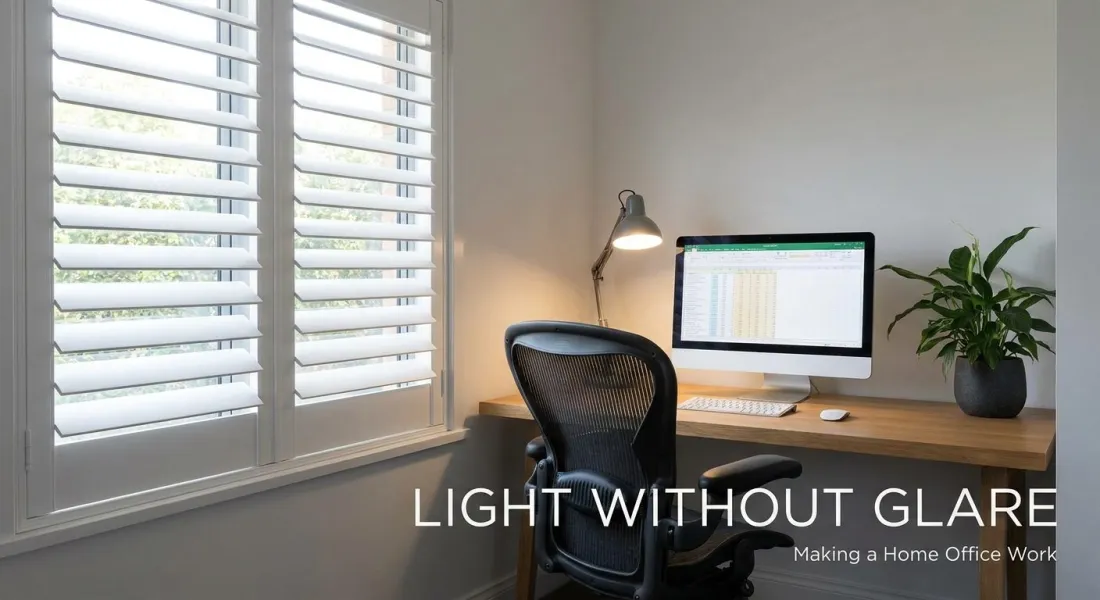
A desk under a west-facing window looks perfect in the estate agent's photos. Then it's 4pm in February, the sun is sitting at roughly eye height, and you're typing with one hand shading your face. By the end of the week the blind is down, the ceiling light is on, and the room you chose for its daylight feels like a cupboard.
That pattern is common, and it's usually fixable without giving up the window. It comes down to understanding where the glare is coming from and having a way to adjust it in seconds.
Why a desk by the window so often ends in squinting
Screen glare in a home office almost always has one of two sources. The first is direct sunlight coming through the glass and landing on the monitor or keyboard, or straight into your eyes. The second is quieter: daylight bouncing off pale walls and a white ceiling, which lifts the background brightness of the whole room. Your screen then looks washed out, even when no sunbeam touches it.
Most people deal with the first culprit and ignore the second. They fix the beam, but the screen still looks flat and tiring.
The trap of closing everything
The usual response is to shut out the lot. Blind down, curtains pulled, problem solved. Except now the room is dim, so the ceiling light goes on, and you've swapped the soft, free, changing light that made the spot appealing for a flat overhead bulb. You've also created a new reflection on the screen from the bulb itself.
It feels like a sensible fix at the time. In practice you've given up the best thing about the room.
Why compact rooms make it worse
In a large room you can shift the desk to another wall. In a box room, a spare bedroom or a nook off the landing, the desk usually has to go by the only window, because that's the only place it fits. There's no "move it over there" option, so the window treatment has to do all the work.
Small rooms also have less space for light to spread and fade. A bright patch has nowhere to go, and it tends to land on you.
What this article sets out to do
The aim is to keep the daylight, control where it lands, and do it without hauling something up and down all day. Plantation shutters are very good at that, and the rest of this piece explains why. They are one good answer, though, not the only one. Blinds and curtains win in some situations, and a later section covers exactly where.
Read your window before you place the desk
Before you think about what goes on the window, decide where the screen sits. The best position is usually side-on to the window, so light passes across the monitor instead of hitting it. Face the window and you'll fight silhouette and eye strain, because your eyes keep adjusting between a bright view and a darker screen. Put your back to it and the glass reflects every bright thing behind you.
What each aspect does
- North-facing: steady, soft, fairly cool light all day. Little control is needed, and shutters here are more about privacy and neatness than glare.
- South-facing: strong light around midday, and a low sun in winter that reaches deep into the room.
- East-facing: bright, early glare that can be harsh from sunrise to mid-morning, then the room settles.
- West-facing: a quiet day followed by a late-afternoon blast, often just when you're in back-to-back calls.
The sneaky one is the low winter sun. In the UK it sits so far down the sky that it can hit a screen at head height, even in a room that felt perfectly comfortable in July. People often buy for summer and get caught out in January.
A worked example: the west-facing box room
Picture a 2.5 by 3 metre box room with one west-facing window and the desk tucked beneath it, chair facing the glass. In the afternoon you're staring at a bright sky, and low sun lands across the desk from about 3pm. Shading the window cuts the view and the daylight with it.
Now turn the desk 90 degrees, so the window is on your left or right. The sun crosses the screen rather than hitting it, and you're no longer looking into the brightest part of the scene. The same window now needs far less correction, and the louvres only have to deal with the angle, not fight a head-on beam.

A simple test before you order
Sit at the desk at three times of day, say mid-morning, early afternoon and late afternoon. Each time, note where the brightest patch falls: on the screen, the keyboard, your face, or the wall behind you. Do it on a sunny day if you can, and ideally repeat it once in winter.
This matters before you order because it shapes the spec. If the trouble is only the lower part of the window, at screen height, you may want to control that section separately and leave the top open for light. Tier-on-tier shutters do exactly that, with independent top and bottom panels. If the glare hits the whole pane, a full-height arrangement makes more sense.
How louvre tilt turns harsh sun into soft daylight
The useful trick with adjustable louvres is that you're not choosing between light and no light. Tilt them upward and incoming sunlight is sent towards the ceiling. Hard, directional light becomes soft ambient fill, bounced down from above, instead of a beam across the keyboard. The room stays bright, but the brightness is gentler and doesn't point at your screen.
Angle the louvres downward, or close them nearly shut, and you cut the brightest direct light while still letting a thin amount through. That's the setting for a south window at midday, when the sun is at its strongest.
Privacy without darkness
Shutters can keep full privacy with the louvres open at around 45 degrees, because the angle blocks the line of sight from outside while light still comes in. That suits a ground-floor office facing a street, where you want daylight but not an audience. A roller blind can't do this, as it's either fully open or fully closed.
A rough day routine
- Morning, east light: louvres tilted up so the low sun bounces off the ceiling instead of across your desk.
- Midday, south window: louvres nearly closed, with enough of a gap to avoid reaching for the lamp.
- Late afternoon: adjust again for the low sun, usually tilting down just enough to cut the beam at head height.
Each change takes seconds, and none involves pulling a cord to the top of the window and hoping it sits straight.
Why the ceiling matters
The upward tilt works because light bounces off a white ceiling and spreads out. That's why a matt, pale ceiling helps: a glossy one throws back a hot spot and can cause its own reflection, while matt paint scatters the light evenly. If your ceiling is dark or heavily textured, you'll get less benefit from the effect.
Heat, fading and small rooms
Louvres also cut heat gain and help protect furniture and floors from UV. In a small room that warms up quickly, with a laptop and maybe a monitor adding their own heat, that's more than a side benefit. A south or west office can go from comfortable to stuffy in an hour, and angling the louvres is a quicker fix than opening a window onto street noise.
One practical detail is worth asking about when you choose a design. A tilt rod, or a hidden-tilt mechanism with no visible rod, lets you make small adjustments mid-call without leaving the chair. A tiny shift of a few degrees when the sun comes out from behind a cloud is far easier than getting up to deal with it.
Where shutters beat blinds and curtains, and where they do not
A roller blind is effectively open or closed. Part-lower it to cut the glare and you usually end up with a bright strip of sky across the top, which throws uneven light onto the screen and shifts as the sun moves. Pull it all the way down and you have lost the daylight you wanted by the window in the first place.
Curtains have their own problems. Sheer fabric softens the light, but it also dulls the view and offers very little privacy once it is dark and the lamp is on. Heavier fabric does the opposite and shuts daylight out entirely. Neither lets you say "a bit less from the left, please."
Blackout solutions will certainly stop glare, but then you rely on artificial lighting for the working day. Louvres let you fine-tune the angle and keep usable daylight, so you can tilt the slats to send light up toward the ceiling while the room stays bright. Even at around 45 degrees, you keep a good level of privacy from the street, which a half-raised blind cannot manage.
Layering drapery over blinds is a perfectly sound, flexible approach. The cost is wall space either side of the window and a daily routine of adjusting two things instead of one. In a compact room, that fiddling adds up.
Honest limits
Shutters are not the answer to everything. If the room is only used in the evenings, glare is not your problem and the choice comes down to looks and privacy. If it doubles as a bedroom that needs total darkness, standard louvres will let thin lines of light around the slats. You would want a blackout panel arrangement or a layered option, such as a lined curtain behind or over the shutter. We cover that kind of setup on our blackout shutters page.
The cost question
Shutters cost more upfront than blinds, and there is no dressing that up. What you get is a fitting that lasts: it wipes clean with a damp cloth, does not fray, fade at the fold or sag, and does not need replacing when a cord snaps. Spread over the years you will use the room, the gap narrows considerably.
When you compare quotes, work on a price per square metre basis and check what is included. Some quotes bundle measuring and fitting, others add them later, and a lower headline rate can stop looking low once you do.
Making a compact room feel bigger, not boxed in
The common worry is that shutters will make a small room look smaller. In practice, a slim frame in a light colour sits flat to the window and reads as part of the wall rather than as an extra object in the room. Heavy curtains with a pelmet and tie-backs usually do far more to crowd a window than a neat shutter does.
Mounting the shutters inside the window recess has two practical benefits. It leaves the sill free for a desk lamp or a plant, and it avoids the curtain stack that eats into the wall space beside a desk. In a narrow room, those 20 or 30 centimetres either side matter.
Swing clearance and the desk edge
Hinged panels need room to open. In a very tight room, consider bi-fold or tracked panels that fold back flat against the frame or slide along it. Before you settle on a layout, check where the desk edge and the chair will sit when the panels are open, not just when they are closed. A chair pushed back into a swinging panel gets irritating quickly.
Keep the desk positioned so it does not block access to the shutters, too. The tilt rod needs to be within easy reach, because the whole point is adjusting the angle through the day without getting up and moving furniture.
Louvre size
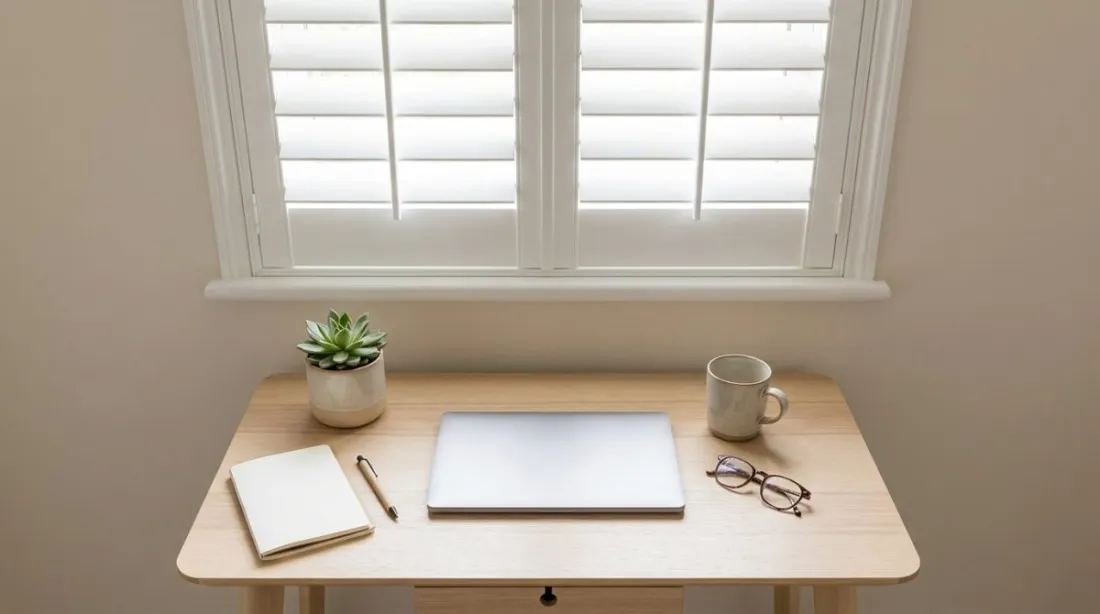
Louvre width changes the feel of the window. Smaller louvres, around 63mm, give a finer, busier look and slightly more precise control over where the light lands. Wider ones, around 89mm or 114mm, show more of the view when open and look calmer on a larger window. On a small window, a very wide louvre can leave you with only a few slats, so test the proportions against the actual opening.
A spare room that does two jobs
Picture a box room that is a guest bedroom for a few nights a month and an office the rest of the time. With shutters, the guest gets privacy from the street without a heavy curtain, and you get glare control for the screen on a bright morning. The furniture stays exactly where it is. Nothing needs to be rehung or swapped between roles.
Finish matters as well. A matt white or soft neutral reduces glossy reflections on nearby screens, whereas a high-gloss paint can bounce light straight back at you. If you want to see how a finish looks before committing, our AI window preview lets you try it on a photo of your own room.
Bays, arches, skylights and other awkward windows
Awkward windows are where a fitted, made-to-measure approach earns its keep, and where a generic blind tends to give up. A few common cases come up again and again in home offices.
Tier-on-tier and bays
With tier-on-tier shutters, the top and bottom sections work independently. You can tilt the top louvres up to let daylight in while keeping the lower section closed for privacy and shade on the screen. For a desk near a street-facing window, that split is often exactly what you need.
Bay windows have a different advantage. Each side has its own panels, so you can shade the side that faces the screen and leave the other open. The desk often works best set into the bay's quieter angle, the one that gets the least direct sun, rather than square onto the brightest pane.
Arches, skylights and period windows
Arched and shaped windows can be fitted with made-to-measure fixed or louvred shaped panels. This is exactly where off-the-shelf blinds struggle, because there is no standard product for a curved head.
Skylights and roof windows are a major glare source, as light from overhead hits the screen at an angle that is hard to avoid by moving the desk. Shutters can be made to fit sloping and angled frames, and our skylight and Velux shutters are built with that in mind.
Sash and older windows in period homes are rarely perfectly square. Openings can vary by a few millimetres from one side to the other, or from one window to the next in the same room. Every opening needs its own measurement, not a standard size applied across the house.
Why in-house matters
That is a good reason to choose a firm that measures, builds and fits in-house. When the person who measured is also accountable for the fit, there is no passing the blame between a surveyor, a factory and a fitter if a panel binds or leaves a gap. You have one team to ask, and one team that has to put it right.
Choosing the spec for a room you work in all day
A home office shutter gets used far more than one in a spare bedroom, so the small decisions matter. Moving louvres a dozen times a day will show up any weak spot in the design. Here is how I would work through the choices.
Frame style
Full height panels cover the whole window and give the cleanest look, but the louvres all move together. Tier-on-tier splits the window into independent top and bottom panels, so you can tilt the upper set to bounce light at the ceiling while the lower set stays shut for privacy. Café style covers only the lower half and leaves the top bare, which keeps the room bright but does nothing for glare coming through the upper glass.
A solid lower panel can suit a desk right under the window, since it hides your knees, cables and a tangle of chargers from the street. If you sit with the sill at chest height, though, plain louvres all the way down give you more flexibility.
Louvre size, tilt and material
Narrow louvres (typically around 63mm) give finer control over where the light lands and a traditional look, but there are more of them to see and move. Wider louvres (89mm and up) open up more of the view and have fewer moving parts. In a compact office, I would lean towards the wider size unless the room is period and the narrow look suits it.
A visible centre rod is simple, robust and easy to repair. Hidden tilt looks cleaner but is a matter of taste, and either one works day to day.
For material, moisture-resistant composites are the sensible choice in kitchens and bathrooms, and a kitchen-table office is a good use for them. Our Montana hardwood range suits living areas and dedicated offices. Hardwood is heavier, so on wide panels ask about hinges and how the panel will be split, because a heavy panel on weak hinges will sag over time.

Colour
Matt white or off-white bounces light softly around the room. Darker colours absorb more of it and can make a small room feel dimmer, which then tempts you to switch on bright overhead lights and bring back the glare.
Questions for any quote
- Who measures the windows, and who fits the shutters? Are they the same people who built them?
- How long is the lead time from measure to fitting?
- What does the guarantee cover, and for how long?
- How is the price per square metre calculated, and does it include fitting?
There is no need to decide quickly. Ask for a home visit and samples, then hold them up in your room's real light, at the time of day you actually work. A sample that looks lovely in a showroom can behave quite differently on a north-facing wall at 3pm.
Setting up the rest of the room around your shutters
Place the screen so the shutters, not your back or your face, take the brightest light. Side-on to the window is usually best. Tilt the monitor slightly down so it does not pick up reflections from the ceiling, which is where you will be sending a lot of that softened daylight.
Use a matt or anti-glare screen if you can, and put your desk lamp to one side rather than behind you, so artificial light supports the daylight instead of competing with it. Once the louvres have taken the edge off the sun, turn the monitor brightness down to match the room. Many people leave it at full blast out of habit.
Then build a small habit. Check the louvres at lunch and again mid-afternoon, since the sun will have moved round, and nudge the angle. It takes a few seconds.
If your desk is awkward and the room is tiny, do not chase a perfect setup. The best results come from small, repeatable adjustments, made a little at a time as the light changes.